Andrew Ettinger on the National Year of Reading
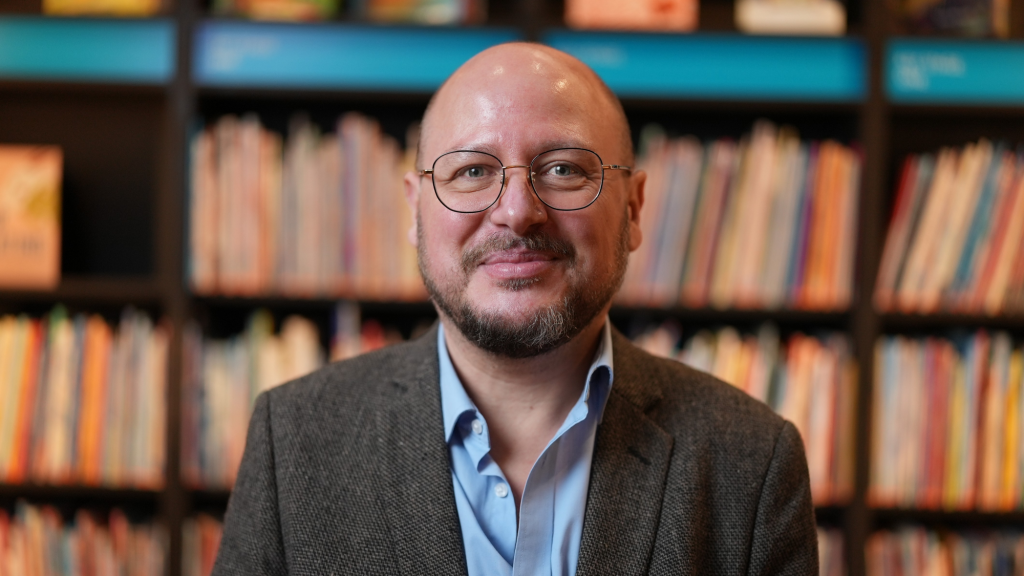
Against the backdrop of troubling research indicating that reading for pleasure among young people was at a 20-year low, 2026 has been designated as the National Year of Reading, a UK-wide campaign to help young people discover the joy of reading and embed it into everyday life. Andrew Ettinger is the Director of Education at the National Literacy Trust, which is leading on the delivery of the campaign. We spoke to him about all things literacy, including what writers can do to get involved.
Can you tell us about your role at the National Literacy Trust and how it relates to the campaign?
I oversee all of our education work, from birth and the early years through to primary and secondary phases. We work across reading, writing and oracy to empower children and young people with the literacy skills they need to succeed in life.
Some of the ways we do this include developing evidence-based programmes that tackle key barriers to literacy engagement, bringing inspiring writers, authors and storytellers into schools, and providing children with opportunities to choose books and diverse reading materials that speak to their interests to take home and keep. We also provide professional development for teachers and practitioners through resources, training and conferences. Many of our programmes are free, and we know they help both teachers and children re-engage with literacy. Alongside this, the National Literacy Trust works directly with communities, particularly in the 21 most deprived areas of the UK where poverty and low literacy are having a serious impact on people’s lives. Children are shaped by what happens both in school and at home, and bringing those two things together makes the biggest difference.
The National Year of Reading combines the public-facing Go All In campaign with direct work in schools and communities. My team runs national assemblies and events, including the World Book Day Footy Quiz, which involved a million children, and an event around Stanley’s Stick with John Hegley and 100,000 early years children. We also have events coming up around cinema and comics, including one with The Beano.
We are also running free webinars, resources and conferences for teachers. Schools are under so much pressure to focus on accountability that joy, wonder and engagement can become difficult to prioritise. We want to give teachers the support they need to give children the time and space to discover how reading can be relevant for them and to then want to read. Reading is valuable in its own right, but it also helps children do better at school in all subjects, become better readers and experience benefits for their wellbeing, creativity and confidence. Our work combines the things that help motivate children with support for teachers to help re-engage them with reading.
Having worked in and around schools throughout your career, including as an English teacher, what has been your experience of young people’s engagement with reading?
I started out as an English teacher around 30 years ago, working at a school in central London. Of course there were no smartphones then, but we did have similar pressures, distractions and cultural forces that made engagement difficult. So we had the same challenges around finding things that children were interested in, what motivated them to want to read. At the time, the big thing was the Romeo and Juliet film with Leonardo DiCaprio and Claire Danes, which was great for making that connection between the contemporary and the text they had to read. Then, as now, it was about making sure that you found the ways to create those connections for children, thinking about what motivates them and how you can bring a text to life.
The National Literacy Trust’s 2025 survey showed that reading for pleasure was at its lowest levels in 20 years. What do you think is responsible for this decline?
There are numerous reasons why we think this is the case. It is particularly when children get to secondary school that a lot of them switch off reading, so we see the biggest drop there. There are lots of changes that happen when you get to secondary school. Teenagers tell us that, at this stage, reading increasingly competes with greater pressures on their time, changing routines, mounting schoolwork and a wider range of interests and hobbies – making reading easier to displace.
There is also something in the culture of secondary schools now, which has been driven by the real accountability pressures schools are under. The curriculum is really packed and there is a lot of learning that needs to be got through. Again, children’s time, but also what you might call their brain capacity to find the space to do the things they enjoy, is more limited.
Going beyond what happens in school and what happens with children, I think there is a feeling – not just in this country, but across the world – that reading has fallen out of fashion and out of favour as something that people do. We know from other research that adults are reading less than they used to as well, so it’s not just a children’s issue. Children obviously look up to the adults around them, and if they’re not seeing that role modelling happening, it has an effect.
You’ve previously written about the positive effect things like video games can have on children’s literacy. While a lot of the discussion has been about reducing screen time, do you think we also need to find a balance of meeting young people where they’re at?
Exactly that. As a parent, and through my job, I know there are lots of risks, particularly around young children being online excessively. We need to mitigate against it and make sure that, when children are online, they are doing so safely and positively. If children are choosing to read and they’re doing so online or on a screen, that can still be really positive, both in itself and as a pathway back to seeing themselves as readers. We make a distinction between what we call “digital reading”, making the choice to read, but doing that on a screen, perhaps through ebooks, blogs or wikis, and what we call “reading digitally”, which might be reading the comments section of a YouTube video. That isn’t necessarily the same positive experience.
We need to meet children where they are, which is obviously more online than I was when I was a child, and recognise that there are positive experiences in online worlds. At the same time, we need to make sure they’re doing that safely and positively, and looking at things that are valid and enriching. There also needs to be space to go out into nature, to pick up textbooks and picture books, and to read and socialise.
The campaign deliberately frames reading through people’s existing interests, be that football or video games, rather than just reading for its own sake. Why that approach?
All of our research shows, and it seems like an obvious point, that children want to read when they can read about things they’re interested in. They disengage from reading when they’re told to read something they don’t like. Obviously, we recognise that sometimes in school you have to do that, but we know the thing that motivates them most is being able to read about their passions and the things that drive them.
It seems like an obvious point, but we needed to make it really explicit and draw it out. If we’d built the campaign around saying, ‘Read books, it’s good for you,’ we wouldn’t have got anywhere, because in some ways they know that already, but it doesn’t drive them to read.
Actually saying, ‘It’s okay to read about football, music or whatever it is,’ validates their experiences and gives them permission to become readers. We know from all of our research that this makes a big difference, especially when combined with proper support from their school and family. Those are two of the things that really break through and help them see and recognise themselves as readers.
We’re now into the second half of the National Year of Reading. How do you think it has gone so far?
From my perspective, it has gone absolutely incredibly. Right from the very start, I got to launch it with lots of others at the Emirates Stadium, and got to meet Gunnersaurus, which was a highlight of my life! We’ve got to do all these exciting things, but more importantly, we’re actually seeing what we think is the impact of this start to come through. In this year’s Annual Literacy Survey, we’ve seen a small but noticeable increase in children’s enjoyment of reading. While that survey was taken quite early in the year, I think it would be very coincidental if it wasn’t in some way related and we look forward to seeing more data come through which will hopefully make that link clearer.
But the biggest thing for me has been that reading is becoming part of the national discourse again. People are talking about reading in a way they weren’t before the start of this year. You might have seen Clare Balding asking Coco Gauff what her favourite book was at Wimbledon, as just one example. We need this kind of national cultural change before things start filtering down to children. But I think that’s the bit I can see. You can feel it: it is tangible both in your personal life and in the media. We are starting to fall back in love with reading.
If a writer reading this feels inspired to get involved and help, what could they do?
Lots! Firstly, they can have a look on the Go All In website, where there’s lots of volunteering options. That could mean working in their community, going into a school and reading with children, or whatever it might be. There’s something for everyone. We really encourage everybody to sign up and volunteer to help inspire more children, young people and adults to discover a love of reading with the National Year of Reading.
For writers in particular, I would say: really talk about what you do. Talk about it with children, families and people in your communities, and online, wherever you go. Share your passion for writing and reading. We know that, without writers, there are no readers. The more writers can share their love of what they do and talk about their process, the more people will want to read (or listen to!) the texts they’ve written.
I know that children’s writers will already be well aware of this, but I think it’s so important to consider children’s interests and experiences and write about those. As we talked about at the beginning, children read the things they’re interested in and can relate to, so it is really about tapping into that.
It’s also so important to promote diverse voices, stories and characters that reflect children’s different experiences and cultures, because seeing themselves in stories is essential, particularly for re-engaging children who don’t see reading as something that’s for them.
The last thing is simply to thank them for everything they do. As I said, without writers, there are no readers. The main thing they can do is carry on writing.
And finally, what are you reading at the moment?
Well, I’m just packing for my holidays, so I’ve got some books I haven’t quite started yet. I’ve got The Vegetarian, a novel by Han Kang, which I haven’t read yet. I also just bought The City We Became by N. K. Jemisin, which isn’t my usual thing. It is fantasy, which I don’t usually read. It is a kind of urban New York fantasy, which is supposed to be wonderful. And because it’s my holiday, I’ve got a couple of decent crime or murder books as well, because it’s the one time I’m allowed to read things like that!
You can find out more about the National Year of Reading here.