Creators Emergency Summit
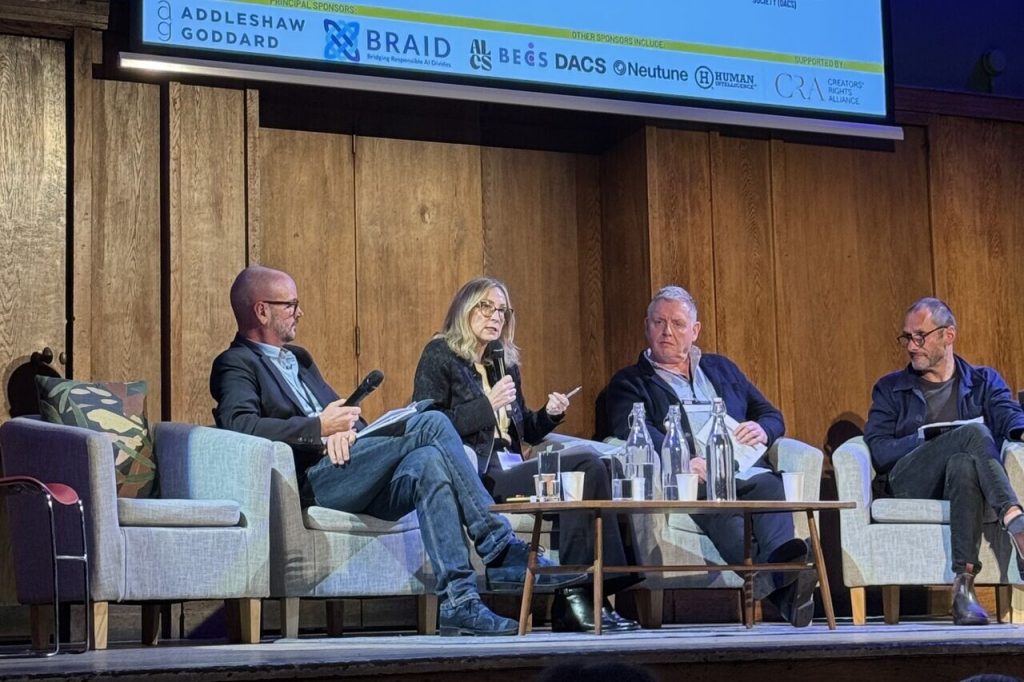
The Creators Emergency Summit, of which ALCS was a sponsor, took place in London on 13 October, with Chief Executive Barbara Hayes taking part in a panel discussion on AI licensing and the important role of collective management organisations (CMOs).
Organised by Charting Gen AI, the summit took place at Conway Hall and brought together creators, representatives from the creative industries, policymakers, legal experts and technology specialists. Following its inaugural event in March, the summit returned to examine the latest developments in generative AI and explore practical ways to protect creators’ rights and livelihoods.
The summit opened with a keynote from Baroness Beeban Kidron, who discussed the ongoing debate around AI and copyright and the publication of a new report from the University of Oxford’s Institute for Ethics in AI. The report sets out recommendations for protecting creators’ rights, focusing on ownership and consent, greater transparency from AI companies, and the development of a fair licensing market. This was followed by a panel featuring politicians from across the political spectrum, who discussed the Government’s approach to AI and copyright and the options available to policymakers.
Legal protections for creators were another important focus. Novelist Andrea Bartz, one of the lead plaintiffs in the copyright lawsuit against AI company Anthropic, spoke about her experience, following the case’s $1.5 billion settlement. A separate panel, ‘Using the Law’, explored the legal avenues available to UK creators, including the potential for collective legal action and the application of contract, privacy and human rights law.
Other sessions examined the practical challenges facing different creative professions. Representatives from the Society of Authors, Association of Photographers, Independent Society of Musicians, Association of Illustrators and Equity discussed the impact of generative AI on their members and the protections they are seeking. The ‘Tech That Protects’ panel explored technological solutions for identifying and protecting creative works, including content authentication, provenance tracking and AI detection tools.
AI licensing panel
Barbara joined Christian Zimmermann, Chief Executive of the Design and Artists Copyright Society (DACS), and Kevin Francis, Vice Chair of the British Equity Collecting Society (BECS), for a discussion chaired by Kester Brewin, Associate Director of the Institute for the Future of Work.
The panel focused on the work of collective management organisations in developing licensing arrangements for AI, and how these can provide creators with greater control over the use of their work and opportunities for remuneration.
Barbara outlined ALCS’s longstanding role in securing payments for writers, from photocopying and scanning through to newer digital uses. She highlighted the extensive experience built up by ALCS and other CMOs over several decades, and the regulatory requirements around transparency and reporting that they must comply with. These established systems and expertise put CMOs in a strong position to develop licensing solutions for AI.
Barbara then outlined two areas of progress in developing licences to ensure authors are paid for AI uses. First, the workplace permissions added to Copyright Licensing Agency (CLA) licences last year, which allow licensed businesses and public sector organisations to use legally acquired copyright material from licensed works when prompting AI tools, for example by asking an AI system to summarise an article. Barbara highlighted that ALCS made its first payments to members for these licensed workplace AI uses, with more expected in March 2027.
She also updated attendees on the development of the separate licence for AI training, developed with the CLA and Publishers’ Licensing Services (PLS), which allows eligible writers to opt-in and aims to secure payment when their works are used to train, fine-tune or augment generative AI models.
Barbara emphasised that this approach reflects the views expressed in our 2024 survey of members, which found strong support for licensing arrangements that would provide remuneration while allowing writers to make their own decisions about participation. The aim is to develop a workable licensing market that enables AI companies to access content legitimately while preserving creators’ choice and control.
ALCS will continue to work with its partners across the creative industries to develop practical licensing solutions that protect writers’ rights and ensure they receive fair payment for the use of their work.