Interview with poet John Agard, CLiPPA winner
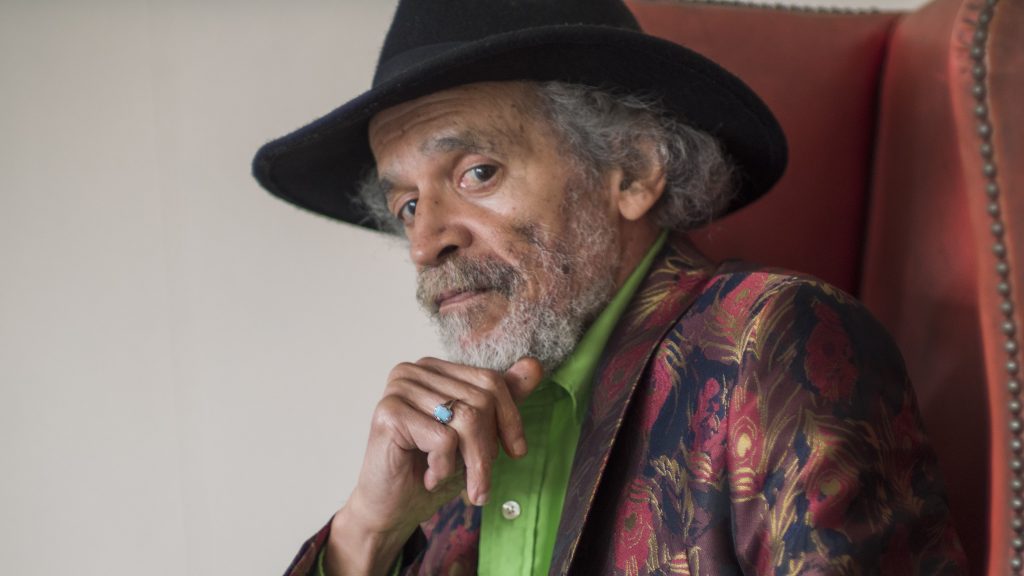
John Agard has become the first poet to win the CLiPPA, CLPE's annual award for published children's poetry, three times, most recently for The Poetry World of John Agard, illustrated by Shirley Hottier. Following the ceremony at the National Theatre, watched by hundreds of children in the room and thousands more in shadowing schools, we spoke with him about the award, his poetry and he reality of poets trying to make a living.
Congratulations on winning for an unprecedented third time. How does it feel winning this one compared to the previous two?
Of course I was happy to receive the first CLPE poetry award shared jointly with my poet-wife Grace Nichols for the anthology we put together (Over The Moon And Under The Sea). Then, happy to later win it for The Young Inferno (a teenage spin on Dante’s classic Inferno, illustrated by Satoshi Kitamura. I am happy to receive the recent Award for The Poetry World of John Agard illustrated by Shirley Hottier (Published by Janetta Otter-Barry and edited by Charlotte Hacking). But how does one begin to compare and measure happiness?
But it’s so important, the CLiPPA, because it brings to the fore and it gives a central platform and a central moment for poetry. The award show itself is magical; there’s Chris Riddell, to my right, doing his feverish sketches, the poets coming forward to perform, and then involving the children themselves. It’s a very exciting event, I love being there.
What is it like performing poetry to children and how does it differ from performing to adults?
The language would be in a more child-friendly key, but the performance would be the same. As I am performing to the child in the adult.
The Poetry World of John Agard features poems written in the 70s and 80s and yet they still resonate with young people today. Why do you think that is?
It’s nice to hear that poems written decades ago still speak to today’s generation. I guess they resonate because I was lucky to catch the right words in the right order. Or maybe the words in the right order caught hold of me.
Some of the poems put Guyanese Creole in front of British schoolchildren when nobody else was. Why was it important that they heard it?
It is crucial to know that the English have many registers of speech. There are Creoles around the world, so to speak. My mother could shift easily from grammatical English to the most down-to-earth Creole and that fluidity was part of my life. That’s what inspired me to write the early collections such as Say It Again Granny!
You’ve been an inspiration to many young, aspiring poets. What advice would you give a child in one of those shadowing schools who wants to write their own poems?
I would invite them to read as much as possible. To find books or materials that excite them. To see it as a journey of discovery. As I said in my acceptance speech at the National Theatre, books feed books, words feed words.
In The Poetry World of John Agard, I explain that objects hold stories and memories. The poems in Grandfather’s Old Bruk-a-Down Car tell of different objects that are special to different people. For example, one poem was inspired by a typewriter and my mother herself was a typist, skilled at shorthand. I remember her over her typewriter with carbon paper. Have you a favourite object that means a lot to you? Well, that object might also inspire you to write a poem
You’ve sustained a career in poetry, not an easy field to earn a living in, for over four decades. What has made that possible, and what’s changed for poets trying to do the same today?
The reality is that you can’t really make a living from the royalties of published poetry whether it’s a slim or a fat volume. Those poets who manage to live on their poetry do so by the grace of the g-word: GIGS. Invitations to perform at literary festivals, spoken word events, or, the occasional trip overseas (paid for with the promise of an honorarium, a big word for a modest fee).
What are you working on now — and has your writing changed over the years?
Not a great deal, though some of my more recent poetry has moved closer to theatre, and appeared in one-person shows. At the moment I am working on some new pieces that explore curiosity, and an adult collection where spices have their say. But curiosity is a great muse.
ALCS is proud to sponsor the CLPE Poetry Award. You can find out more about the award here.