Interview with Ruth Millington, winner of the ALCS Educational Writers’ Award
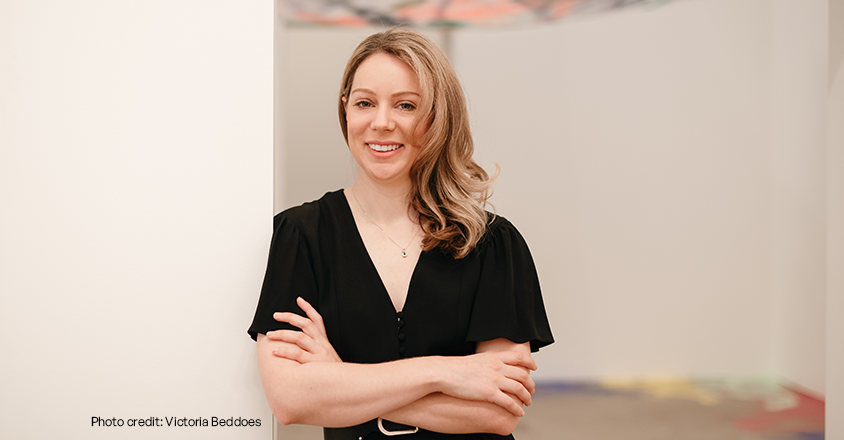
We spoke with author, art historian and curator Ruth Millington, who won the ALCS Educational Writers' Award for 'This Book Will Make You an Artist', along with illustrator Ellen Surrey.
How did it feel to win the Educational Writers’ Award?
It felt amazing, I really wasn’t expecting it. That book was four years in the making, and I definitely put all my heart and soul into it. It also meant a lot to be able to share art and art history with kids. I don’t think there are that many prizes for children’s authors, which makes it feel extra special.
What is your own relationship to art and how has it shaped your career?
It all goes back to school. I had the most incredible art teacher, and his art room was like a second home for me. With art, I could be free, I could experiment and I could make mistakes, which are all massively important. He always combined art history with practical work, despite the two subjects often being separated out. And that’s the approach that I took in this book. I wanted to bring them closer together, because there are so many practical lessons you can learn from looking at great masterpieces from the past.
What was your background before writing?
I studied Liberal Arts at university and then did an MA in Art History specialising in modern and contemporary art. After that, I just knew I wanted to work in museums and galleries, so I moved to London and started working in museum education, which is where a lot of my ideas for the book came from. I was creating workshops for families and kids, doing fun, creative activities that they could easily do with accessible materials. From there, I moved into the commercial art world and sold Monets, Renoirs and Chagalls for an art dealer in Mayfair, which I did for three years.
During that time, I was doing a lot of writing about the artworks and really getting to know the history beyond what you’re taught at school or university, which was fascinating. Now, I mix writing with curating and broadcasting, and I also work with contemporary artists, providing mentoring and running boot camps.
What inspired you to write This Book Will Make You an Artist?
It was inspired by my art teacher’s approach. You learn a technique or a style by first looking back at art history. You want to learn about landscape painting? Let’s first have a look at Monet and how the impressionists divided up their brush strokes. Looking at these works and how they were achieved is going to inspire your own practice. So I wanted to write a book that gave fun facts and biographies of important artists, but I also wanted to open it up to the children reading and get them making art for themselves. Because, unlike other subjects, art isn’t about being told the right answers. What I wanted to do was open up a new world for children to explore. There’s no “correct” way for them to think about art, it’s up to them. I also think practising art can encourage them to go to museums and learn more, so it becomes this circular thing.
Why do you think it’s important for children to understand and engage with the visual arts?
I think we live in a world where people strive for perfection, and I’ve seen that in a lot of children and families I’ve worked with. For me, art is the perfect antidote to that. Because in art, you can be creative, you can be messy, you can make mistakes. You can also just be yourself without having to perform for social media or for other people’s expectations.
When you received the award you spoke about art being more important than ever in the age of AI and scrolling. Could you speak more on that?
I’m concerned that we’re all consuming rather than creating. And the content we consume can be really harmful to our self-worth, to our attention span and to our creativity. I think it’s crucial that everybody makes some space, away from screens, to focus on learning something new and expressing themselves creatively. It’s really good for your brain, for your confidence and for your mood too. It’s not about creating a masterpiece, it’s about the process itself.
With AI, there’s so much focus on “productivity” and doing something quickly, that we’re losing the personal elements that make these things worthwhile in the first place. Yes, you could use AI to write a book in two weeks. But you’re missing out on the joy of actually engaging with the process, of thinking and creating and honing your craft. With This Book Will Make You An Artist, the most enjoyable and rewarding part was the process of writing it. Not finishing it, or winning an award for it.
You won the ALCS Educational Writers’ Award with the illustrator of the book, Ellen Surrey. What did she bring to the project?
Ellen’s amazing! The publisher gave me a shortlist of illustrators who they had in mind to illustrate the book. As soon as I saw Ellen’s name, my heart leapt because I already owned one of her books and I love her style. Her dad was a Disney animator, and her work just has this cinematic and narrative feel. She can tell stories amazingly well and I just knew she’d be able to bring all these artists from the past to life for the kids in an evocative and atmospheric way.
For every artist in the book, she perfectly captures the world they worked in. You have Monet painting in his garden and Andy Warhol in his factory. She managed to capture their likeness and working methods with so much detail. Kids can spend ages looking for those little details and finding pieces of the puzzle.
As well as including iconic artists, the book also features lesser-known ones like Janet Sobel. How did you decide who made the cut and was that a difficult process?
I started with a list of maybe 60 potential artists to include in the book. And I was really clear from the start that I wanted it to be 50/50 men and women, because women have been underrepresented in art history, as have Black and working-class artists. As well as representing the diversity of artists, I also wanted to show the diversity of art forms. So as well as painting, we cover things like collage and soap carving with Barbara Hepworth.
We were also limited by who would grant us the rights to be included. We wanted to cover Jackson Pollock and abstract expressionism, but they didn’t respond. In the end, I was delighted because it meant we could include Janet Sobel, a pioneering Ukrainian-American painter whose style actually inspired Jackson Pollock.
How did you find the process of adapting your writing to a younger audience?
It’s definitely harder than it looks. Trying to explain concepts like Impressionism in less than 300 words, while being fun and accessible, is really challenging. I shared some parts with a five-year-old, and she was a really tough critic. She told me, “this is too much like school, you need to make it fun”. After that, I tried to bring out the human stories rather than just reciting facts. Despite finding it more challenging, I also found it more rewarding. It actually helps you to understand the subjects better by getting to the core of things. If you can explain impressionism to a five-year-old, you can explain it to anyone.
What would you say to a child who likes art but thinks they’re not artistic?
I’d say there’s no right or wrong in art and actually some of the greatest artworks were happy accidents. If drawing or painting feels like too much pressure, just play with shapes, colour and form before focusing on something realistic or complex. We also forget that art requires practice just like anything else. You wouldn’t just run a marathon, you would train for months or even years beforehand. It’s no different with art. You have to build up your confidence, your ideas and your technique. There are stepping stones to get there, and I hope this book encourages kids to just have a go, because that’s where every amazing artist starts.
Are you working on any other projects at the moment?
I’ve got a new children’s book coming out in August called The Science of Art with Dorling Kindersley. Science and art have always been kept very separate and seen as opposites, and this book aims to bridge that gap and bring them together. It looks at the magic behind masterpieces, and how artists have always used principles from science and mathematics to bring their ideas to life.
What have you read recently that has struck a chord with you?
Lately, I’ve read so many Lee Child books because I’ve just curated an exhibition about him. It’s not my normal go-to, but they are great stories of outsiders. And I like that he’s from Birmingham, where I also live, because the literary world can be extremely London-centric. Working with him, he told me something very important. He said, “just work on your craft, work on your product, and everything else will fall into place.” I think we live in a world where everyone wants to be recognised and have a huge following, but they’ve forgotten that the craft comes first.
I would also recommend a book called All the Beauty in the World: The Metropolitan Museum of Art and Me. It’s a moving book written by one of the security guards who worked there. He talks about his experience watching people view the artworks. It’s such an amazing book because it shows that there are so many different perspectives and stories to take away – the same painting can mean something completely different to a different person on a different day. It made me realise that art is pretty much eternal, and really shows why galleries and art museums are so vitally important.
You can learn more about Ruth and her work here.