Interview with V.S. Pritchett winner, Hannah Webb
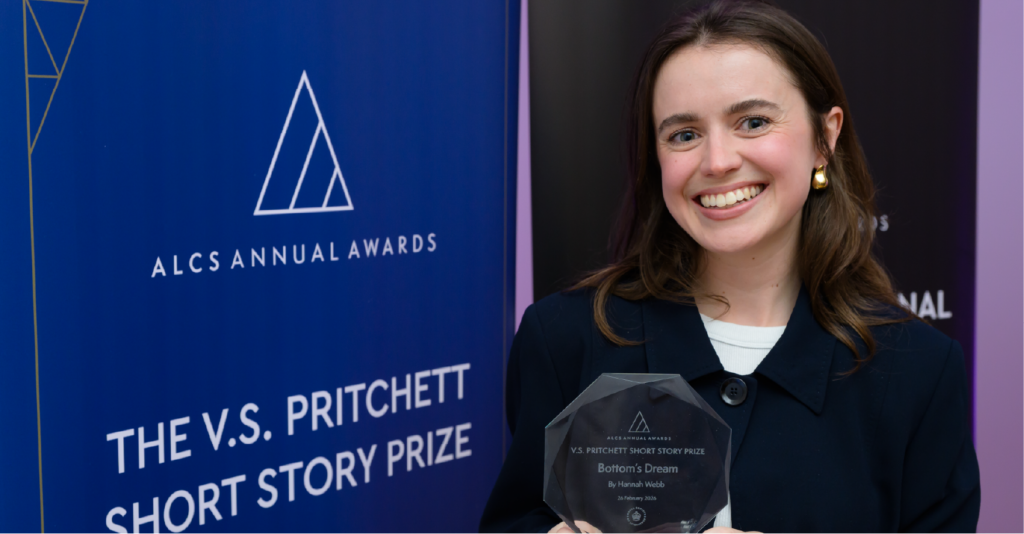
In February, Hannah Webb won the V.S. Pritchett Short Story Prize for her short story ‘Bottom's Dream’. We spoke with her about her winning story, the short story format and her writing process.
On winning the V.S. Pritchett Short Story Prize…
It felt amazing, it’s a real boost. As I said when I won the award, writing can be quite a lonely experience. For a long time, the thing that I’m writing lives only inside my head. Putting it out there is really scary. But the feeling of knowing someone has read what you wrote and enjoyed it, it’s so wonderful. I’m trying to let it boost my confidence. I often feel like an impostor when I call myself a writer, but I think winning has definitely helped with that!
On writing…
I can remember really loving writing when I was young. I was a bit of an anxious child, so at school I was always really worried about getting things wrong and right. But when writing creatively, that doesn’t matter. It just felt very free to me. I drifted away from it for a while, but rediscovered it in the last few years, which led me to do a Creative Writing MA at Birkbeck. They’ve got such great teachers, and I met some really talented people, who I still meet with at an alumni writing group. I’m also a bookseller now, so I get to spend a lot of time chatting to people about what they’re reading, giving recommendations, getting them in return. My To Be Read pile is enormous. Reading and writing have become a big part of my life again, like they were when I was younger, and it’s lovely to have come back to that.
On the short story format…
I read a fantastic line from the short story writer Sarah Hall, who described short stories as “a bullet wound, small precise entry point of first sentence, gaping metaphysical hole on exit.” I think that speaks to something about the form, finding a very specific moment and bringing all the parts of that moment to life, but in doing so opening up much bigger questions. The form can contain a lot of ambiguity and is comfortable with that. It can leave questions unanswered in a way that doesn’t feel unsatisfying. In that sense, it gives a lot of trust to the reader. You have the space to form your own ideas and opinions about what is raised.
On the inspiration behind Bottom’s Dream…
I feel like inspiration is something that I have to think about retrospectively. Often I sit down with an opening line or a character and then go from there. But I think I wanted to write something that explores the texture of online life, and using the fragmentary nature of the short story format to enact that. I also wanted to explore different tonal registers. The writer Miranda July is wildly funny and movingly profound, often in the same paragraph, and that’s the kind of thing I aspire to. The themes of ‘Bottom’s Dream’ are quite dark, but I hope there’s also some levity.
How the story evolved…
I find it helpful to not have a clear destination in mind and allow myself to take it where I want. Initially, it was a camping trip, so it has changed quite a lot. That’s where workshops with other writers are really helpful. When I showed one of the first drafts to a friend, they said they didn’t think I had found what the story was about yet. That feedback put words to a feeling I had about the story myself.
The role of performance…
It made me realise that it was about connection, between father and daughter, between their unit and the rest of the world. Connection today can mean lots of different things. Which then pulled me towards the idea of internet forums, and also the intertextuality of weaving in a dramatic background with A Midsummer Night’s Dream. This performance element gradually became more significant, as Nick is increasingly trying to present himself as someone who is getting through it all and thriving. But performance also has this possibility of transcendence, of going beyond the boundaries of everyday life, which is what I wanted to capture.
On the imagined reader…
I am hopeful when I write, in the sense that I do imagine it being read by someone. But until I’ve sent it to one of my friends for feedback or submitted it to a competition like this, a reader only really exists as a vague idea in my head. George Saunders has some good advice on this, to go through each line and note whether it adds to or subtracts from the readers’ experience. I find that a useful way of contextualising the reader in the story, and not being afraid of them.
On the writing process…
I wake up really early and I quite like doing my writing before the rest of the world is up. I feel like I can get lots of work done before 9AM. It’s a lot of sitting very hunched over my laptop. I have a bad habit of putting my face really close to the screen. I think the main adjective I would use to describe my process is slow. I’m not very good at leaving something and moving on, I have to keep working on each sentence until I’m happy with it. If I find myself in a bit of a rut, reading an essay or listening to a conversation between two writers helps free me up.
Recent reading…
I just finished All My Puny Sorrows by Miriam Toews. She’s such an amazing writer. It has so many different tones to it. She writes about objectively very dark and melancholic things but with so much whimsy and life. This year I’m going to try to read all of her works, that’s my new project.