“The one thing they can’t take away” – Katie Webb remembers Maureen Duffy
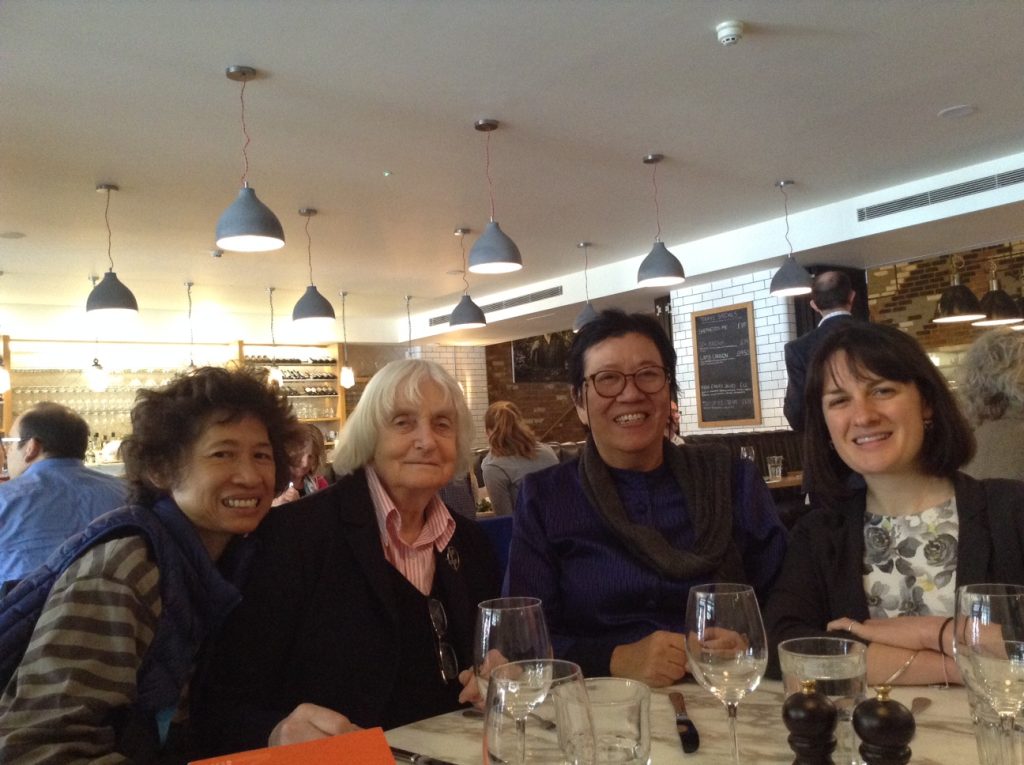
Katie Webb was the first Administrator of the International Authors Forum, which brings together authors' organisations from around the world. She pays tribute to the life of her friend and mentor, Maureen Duffy, who sadly passed away last month.
I first met Maureen in January 2010 at the ripe old age of 22. A university professor introduced me to her because she needed help sorting her archive, which she was donating to King’s College London, and also because of the inspiration Maureen took from medieval literature in her own writing. (I was completing an MA in Old English Literature at the time.) I bicycled over to her house in Fulham. We passed afternoons in her sunny attic sorting endless papers into piles: manuscripts; copyright; personal; recycling – and chatting about the memories they evoked.
The first visit left me fascinated and impressed by how well-travelled Maureen was, thanks not only to her career as a writer, but also her lifelong fight for authors’ rights – and simultaneously horrified and reassured by the fact that when I tipped over a full cup of earl grey tea she made me, so near to her precious archive, she didn’t seem fazed at all. It was the start of a great friendship and one of the most important influences of my life.
I soon learned about her involvement in the little-known but important world of defending authors’ copyright – ensuring they were paid fairly for their work – which seemed to marry my interests in the law conversion course I went on to study, and literature, with my bachelor’s and master’s degrees. Working with Maureen always felt immensely privileged, professional, necessary and yet warmly personal, affable and easy. She introduced me to Barbara Hayes at ALCS, under whom I undertook an internship as her lobbying assistant.
One day, Maureen called me to her house to tell me about an international organisation they wanted to set up to bring together authors from around the world and asked if I would like to do it. She seemed to have no doubt I could. That job saw me battle with inexperience and the difficulties (including the patience required) of establishing an international not-for-profit organisation on a shoestring, ably guided by Maureen and Barbara. It took me travelling around the world, most often with Maureen to represent authors at the World Intellectual Property Organisation (WIPO) in Geneva, where she had immense standing.
We shuffled back and forth each day between hotel and WIPO, for long days listening to slow-going UN level discussions, meeting people from all around the world and in the little downtime we had, enjoying each other’s company at the hotel breakfast or in a local (Maureen-approved) Italian restaurant, analysing our acquaintances and formulating IAF statements about the importance of copyright to authors. I would scribe while she dictated, always seamlessly, her words pouring from mind to mouth just as her literary writing poured from brain to hand to page, with incredible fluency, barely a correction or edit to be made.
I remember using lunch hours at the office to type the manuscript of her novel In Times Like These, prescient of Brexit, in 2012. Thanks to the Centre for Life Writing at King’s, I organised a big conference in 2013 to mark her life, works and 80th Birthday, with the support of the Centre’s Director, Professor Clare Brant, and a group of professors. Clare also organised a biographical window on the Strand at the King’s campus, marking Maureen’s contributions. I got to know Maureen first as an advocate, then as world-traveler with an open mind and entrepreneurial spirit.
At this point, I thought I’d better get to know her literature. I loved it. You could hear her voice in everything she wrote. The conference led to me organising a series of events with King’s, where Maureen and I studied 50 years apart, bringing together material from her archive as well as contemporary artistic engagement with her work. Those events are documented on the College’s digital collection, Strandlines. I went as far as the Solomon Islands on IAF business, to meet SICWA, the Solomon Islands Creative Writers Association. Each trip was a cultural immersion as well as a mission to create solidarity between authors to empower them to know and strengthen their rights and value their work.
Maureen’s health was starting to decline. In 2023 we celebrated her 90th Birthday. I visited her each time I came back to the UK, always buoyed by seeing her. I phoned, which became less easy as her awareness faltered and I had two children, born in May 2024 and November 2025. She remained unfailingly caring, always asking how the baby was and how IAF was doing. I was able to take both daughters to meet her – the second one just once, in March 2026, the last time I visited Maureen.
Maureen welcomed me into her world as she felt welcome in the world thanks to her immense, intimate and affectionate knowledge of her literary forbears, who made her feel at home. She was dedicated to doing their lives justice, through her own extraordinary creative writing, and her activism which continues to help writers write, to this day.
Her own life had left her orphaned by the time she was 14, having never known her father and losing her mother to tuberculosis, after living through the Second World War and being bombed with her. Maureen is often quoted saying that her mother was independent and brave, as Maureen was herself, and that she wanted to give Maureen an education, because “that’s the one thing they can’t take away from you”. Thank you Maureen, for, in spite of losing your wonderful company, giving me an education nobody can take away from me, on life, love, friendship, loyalty and fighting for what you believe in, and for always believing in me.